
Musical Language and Notation.
When moving to France 10 years ago I not only had to learn the spoken language but also the language of music. Here are a few thoughts for those following in my footsteps.

Sometimes in life one can be forgiven for thinking that one has a particular professional skill completely mastered and “under the belt”. Beware - that’s not the case when moving countries, even if they are only 22 miles apart at the closest point between England and France.
Shortly after we arrived here, I became involved in 2 bands. One was rooted in English and American folk music and as such used English notation, but the other was more French, including a French pianist who had been brought up using French terminology which, in itself, was not surprising, but this meant that, in a band with English musicians, we had two sets of potentially conflicting information to deal with. One in English and one in French.
I learnt my music terminology in England and in Western tradition, and I am pleased to say, proficient at applying that knowledge to the situations I come across, but arriving in France I found some things were different and it was somewhat disconcerting.
In England, and many other countries in the world, music notation uses letter names from the alphabet C D E F G A B C. However, in France, the French use the sol-fa (Solfège). Each note having a specific name rather than a letter.

(See Note: *1)
The reader could be forgiven for thinking that it's a simple matter of learning a new name for each note. Which of course is true …… However, there are two issues here.
When musicians learn to play and become proficient in their skill, they respond to the notation in microseconds. When something changes, this makes the interpretation of the notes and the symbols much slower, so the player becomes hesitant and more likely to make mistakes.
Secondly, in England we use the Sol-Fa in a different way and this is the root of the problem. Mostly, it is used for vocal training where students learn to hear and replicate the intervals between notes. For example Doh to Ray is 1 step in a scale of notes (Major 2nd); Doh to Mi is 3 steps (major 3rd) Doh to Fa is 4 steps ( a perfect 4th) and so on.
This is all fine in the key of C Major or Doh Major as it would be in France.
However, when we change the key of the music (The “gamme” in French) this does not, because, in England we use a moveable Doh which means that the first note of a scale (I or the Tonic note - see *Note 1) is always called Doh thus the intervals within the scale are always the same even if the note names are different. It is the sound which is the same and so it is for this reason the English sol-fa is known as the Tonic Sol-fa.
Each of these note positions has a name, many of which the reader may have heard in general conversation.

(See Note 2)
So here’s the problem:
When the key of the music changes, so do the note names, but in the English tradition the Tonic Sol-fa moves to the first position of the scale or key or gamme. Doh now becomes the first position in the scale; Soh the 5th position; La the sixth.
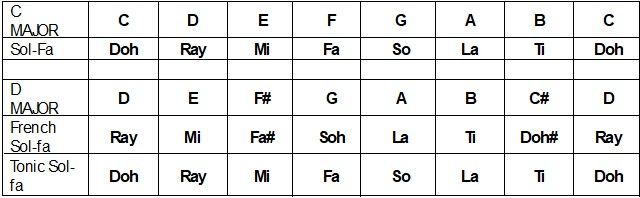
As readers can see, there is an immediate discrepancy between the names of the notes in the Sol-fa and in the Tonic Solfa. Potentially, making an issue with the names of the chords.
In the English system, Doh is the first; the fundamental; the tonic position of the scale so in this example Doh is the note D. So a chord of Doh Major would be based on the first position of the scale and is therefore D Major. However, in the French system Doh is Doh; Doh is C; Ray is D; Mi is E: etc and it never changes. It took me a long time to realise that the Sol-fa names simply replaced the alphabet names in the English system. So the chord of Doh Major is, in fact, C Major. Whatever the key happens to be!
Let's be clear - I'm not saying that other systems are wrong. I am just pointing out the differences, and the time it can take to make a fundamental shift in one’s learning.
There are differences too in the naming of the signs we use in standard notation; the signs we use for each length of note. Another potential cause for confusion.
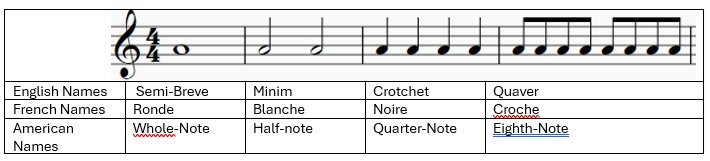
Yes……..Then there's the Americans - see a future post.
Thanks for reading. Comments and feedback are always appreciated.
Note*1
Using Roman numbers is a common feature when students learn about harmonies and they move according to the Key of the music, so “I” is always the first note of the scale no matter what the starting note is.
Note *2
These technical names are used in association with the position they are in any key. When constructing chords, they become useful names to decide issue such as which chord to use and how to change key during a particular piece of music.
Confused? Too technical? Don’t panic, it’s not that important at the moment, just interesting (for some people).
To find more musical terms in other languages CLICK HERE:
Interesting! Look forward to the American edition.